Index Exchange (Index)'s pricing model is designed to provide reasonable fees that are transparent and deliver maximum value to Media Owners and buyers. On this page, you'll learn:
How contractual publisher
 The owner of a website or app where advertisements are served. revenue shares work
How Transparent Dynamic Take Rates work
How to view revenue shares in reporting
How contractual publisher revenue shares work
A contractual publisher revenue share is a revenue share percentage that Index negotiates with Media Owners. The contractual revenue share determines the take rates that Media Owners and Index receive for a completed transaction. For example, a publisher revenue share of 80% means that the Media Owner receives 80% and Index receives 20% of gross media spend, less any other applicable fees, for a completed transaction. Revenue shares may vary depending on numerous factors, including transaction type.
Example
Here's a simple example where there are no extra fees, and Index pays Media Owners directly:
| Buyer A wins an auction at the final bid price of $10.00 CPM |
| Publisher X has a contractual publisher revenue share with Index of 80%, which means that Index has a revenue share of 20%. Index retains 20% of $10.00, which is $2.00. |
| Index remits $8.00 CPM ($10.00 - $2.00 = $8.00) to Publisher X as a final payment from Index. This amount is known as the net bid |


How Transparent Dynamic Take Rates work
The Transparent Dynamic Take Rates program is Index’s smart pricing feature that dynamically adjusts Index's revenue share on a transaction-by-transaction basis. It's designed to boost publisher revenue by increasing the number of bids won through more efficient auctions. It works without changing floor A pricing control used by media owners and exchanges to set a minimum sale price on inventory. prices or requiring buyers to adjust their bids. Publishers always receive a payment for a billing period that reflects an amount equal or greater to their contractual revenue share, and Index continuously monitors this key constraint.
Transparent Dynamic Take Rates determines how to adjust Index's revenue share in the following way:
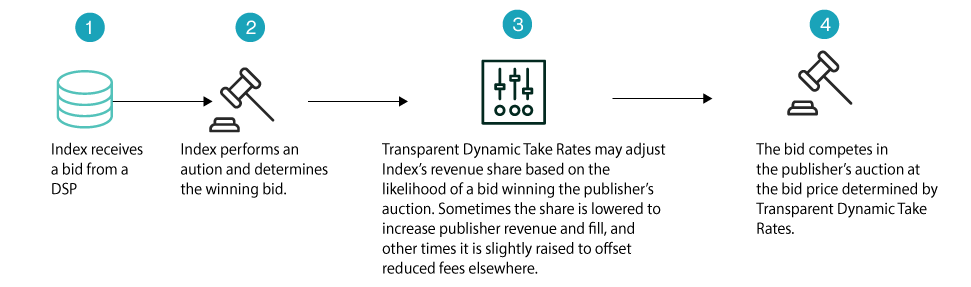
For Index to win an impression, our bid must be the highest among all demand sources. Even when we take a slightly higher margin to recoup costs, we still only win if our bid remains the most competitive option for the Media Owner.
Publishers can see exactly what Index retains as its revenue share on every impression, and every impression is auditable through Client Audit Logs (CAL Client Audit Logs (CAL) API. An API that allows Index customers to retrieve log files for impression and bid event data.) and reporting.
Viewing reporting on revenue shares
You can view reporting for the revenue shares that Index applies in a transaction using Reports in the Index UI The Index UI at app.indexexchange.com that allows you to manage integration settings, such as inventory, campaign, and deal settings., Reporting API An Index product that provides aggregated reporting data that can be delivered through email, Amazon S3 bucket, or pulled through the API. The Reporting API allows customers to create their own customized reports and schedule their automated delivery., or Client Audit Logs (CAL).
Using the Reporting UI and Reporting API
The publisher_revenue_share field in Reports in the Index UI and the Reporting API shows the percentage, as a decimal from 0 to 1, of the Media Owner share of the revenue from a transaction.
To see the revenue share that Index has applied to an impression, subtract 1 from the value in the publisher_revenue_share field. For example, if publisher_revenue_share = 0.80, the Index revenue share applied would be 20% (1 - 0.80 = 0.20).
For more information on how to create reports using the Reporting UI, see Create a custom report.
For more information on how to create reports using the Reporting API, see Reporting API.
Using the Client Audit Logs (CAL)
The pub_rev_share field in CAL shows the percentage, as a decimal from 0 to 1, of the Media Owner share of the revenue from a transaction.
To see the revenue share that Index has applied to an impression, subtract 1 from the value in the pub_rev_share field. For example, if pub_rev_share = 0.80, the Index revenue share applied would be 20% (1 - 0.80 = 0.20).
For more information about how to get up and running with CAL, see Using the Client Audit Logs API.
