Index Exchange (Index) uses the IAB Interactive Advertising Bureau (IAB). An advertising business organization that develops industry standards, conducts research, and provides legal support for the online advertising industry.'s Open Measurement Interface Definition (OMID) to measure impressions for mobile app banners. OMID allows billing notifications to be sent to Index and DSPs when at least one pixel of an ad enters the user’s viewport. We encourage all mobile app Media Owners to adopt OMID because it standardizes the measurement of impressions and reduces reporting discrepancies between all parties. To start using OMID with Index, send
 API = 7 in the Banner object of your OpenRTB bid requests.
In the mobile app banner example below, the following steps describe how OMID works in an OpenRTB An open industry standard for communication between buyers and sellers of online advertising in real-time bidding auctions. It's published by the IAB. interaction between a publisher The owner of a website or app where advertisements are served., Index, and a DSP Demand-Side Platform (DSP). A software platform that automates bidding decisions in real-time and efficiently connects buyers and audiences through an ad exchange or SSP. Also known as a buy-side platform..
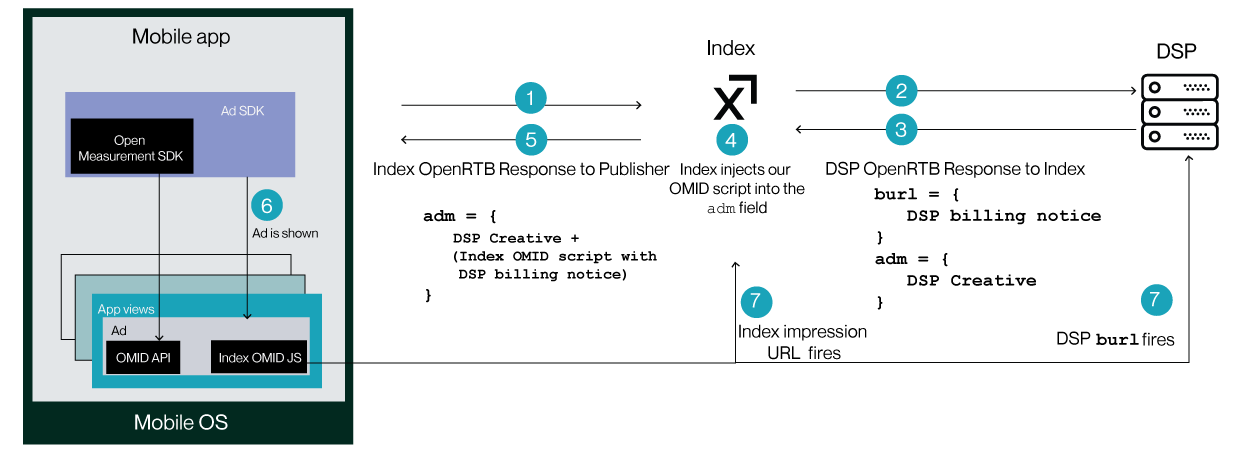
| The ad SDK generates an ad request and sends it to your ad server |
| Index sends a bid request to the DSP. |
| The DSP sends a bid response
|
| Index injects our OMID measurement script into the |
| Index sends a bid response to your ad server that includes the Index OMID script. |
| Your ad server conducts the final auction and if the bid wins the auction, the ad is displayed to the user. |
| When at least one pixel of the ad enters the viewport of the device, Index's OMID script determines that a billable event has occurred and fires both the Index impression notification and the DSP Note: Index uses a time to live (TTL) of three hours for our impression notifications. Our impression notification, as well as the DSP’s, are fired when the OMID measurement script runs, regardless of the DSP’s TTL for impression notifications. Index recommends against pre-rendering creatives in order to reduce discrepancies with all parties. For more information about TTL, see How Index counts impressions. |


