You can use client-side A type of header bidding where the auction takes place on the user's browser. beaconing to send billing notifications (
burl) to Index Exchange (Index). When you use client-side beaconing, the burl is sent from your site or app code, typically from an ads SDK, when a billable event occurs. To use burl with Index, your SDK or server must support HTTP 302 redirects. To enable burl with Index, contact your Index Representative.
In the mobile app banner example below, the following steps describe how burl works in an OpenRTB An open industry standard for communication between buyers and sellers of online advertising in real-time bidding auctions. It's published by the IAB. interaction between a publisher The owner of a website or app where advertisements are served., Index, and a DSP Demand-Side Platform (DSP). A software platform that automates bidding decisions in real-time and efficiently connects buyers and audiences through an ad exchange or SSP. Also known as a buy-side platform..
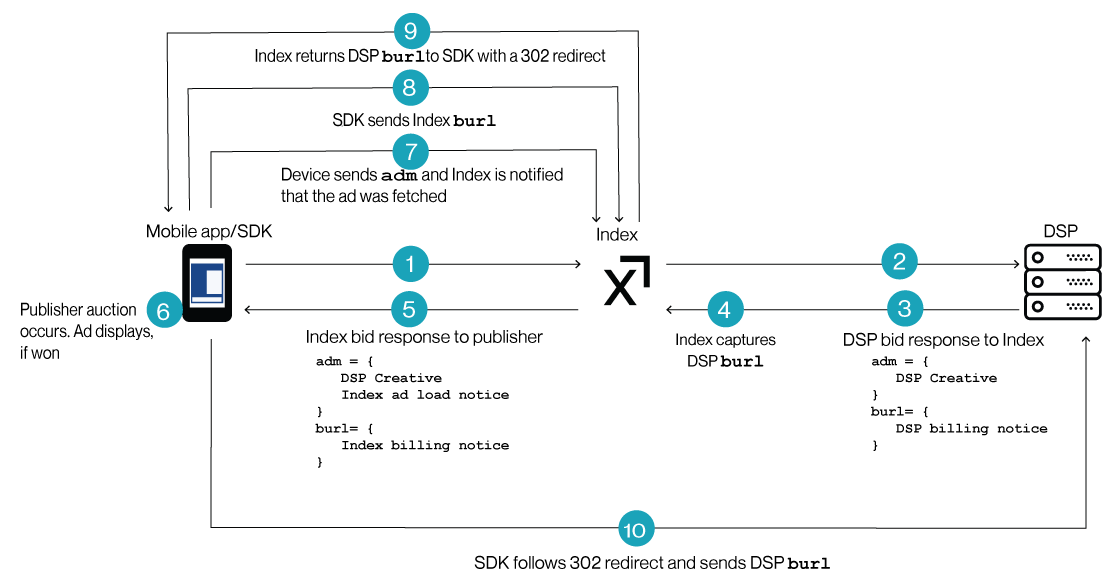
| The ad SDK generates an ad request and sends it to your ad server |
| Index sends a bid request to the DSP. |
| The DSP sends a bid response
Note: Index holds the auction data related to burls for three hours. This is referred to as the impression time to live (TTL). If Index receives the |
| Index captures the DSP's |
| Index sends a bid response to your ad server that includes the following fields in the bid response object:
|
| Your ad server conducts the final auction and if the bid wins the auction, the ad displays to the user. |
| The ad is downloaded which causes the device to send the Index ad load notice, which was inserted in the ad markup ( |
| The device sends the Index |
| Index retrieves the DSP |
| Your SDK follows the HTTP 302 redirect to send the DSP |


